
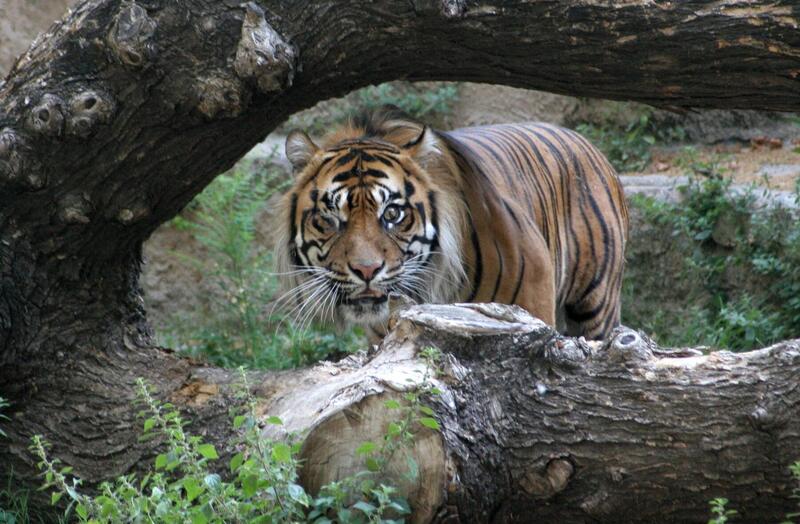
Barcelona Zoo has definitively closed a chapter of its history with the loss of its last two Sumatran tigers, Tibor and Pertama, who died in July and October 2025 respectively due to age-related health problems. With this loss, the Catalan zoo brings decades of exhibiting big cats to an end and announces that it will not replace them, opting instead for a strategic shift that prioritizes native wildlife and Mediterranean ecosystems.
The decision by Barcelona’s city council to transform the space previously occupied by the tigers into the Descobrim la Mediterrània project responds, according to the institution, to a new philosophy focused on protecting local animals at risk of extinction. “This transformation marks a turning point in the park’s strategy, moving away from a focus on exotic big cats to strengthening the protection of local wildlife”, the Barcelona City Council has explained in its official communications.
The legacy of Tibor and Pertama
Tibor arrived at the Barcelona Zoo in 2015 from the Edinburgh Zoo as part of the European Endangered Species Programme (EEP). At eight years old at the time, the Sumatran tiger had already lost an eye due to glaucoma resulting from an injury suffered as a cub. Despite this disability, Tibor was welcomed in Barcelona where, according to the zoo itself, he had a very calm temperament and showed no difficulties interacting with other tigers or with his caretakers.
During his time in Barcelona, Tibor shared facilities with Pertama, the Sumatran tigress who already lived at the park and had been left alone after losing her mate. Both animals took part in European big cat conservation programs, contributing to international efforts to preserve a species classified as critically endangered by the International Union for Conservation of Nature (IUCN). According to the latest census conducted in 2008, the global population of Sumatran tigers was estimated at between 400 and 700 individuals, threatened mainly by habitat destruction and poaching.
The Sumatran tiger is the smallest subspecies of tiger still in existence, distinguished by its darker coloration, a small mane on the nape, and longer facial hair tufts. Although it historically ranged across the entire Indonesian island, today most surviving individuals are concentrated in the volcanic mountain range of Bukit Barisan.
A strategic shift toward native species
The removal of tigers from the Barcelona Zoo is part of an ambitious transformation plan presented by the city council as a commitment to sustainability and environmental education focused on the Mediterranean region. The Descobrim la Mediterrània project, whose gradual opening is scheduled from 2026 onward, will recreate various Mediterranean ecosystems from coast to mountains, allowing visitors to learn about local flora and fauna.
According to official information, the zoo’s new model will focus on species native to the Mediterranean and the Iberian Peninsula, from small mammals to birds of prey and reptiles, with the aim of helping visitors better understand their role in ecological balance. The institution will also intensify its educational and awareness programs on the climate crisis and biodiversity loss, offering interactive workshops and immersive experiences for all ages.
In addition, construction of the Bioscope is planned for 2030, a 7,000-square-meter facility that will address the evolution of species and the history of life on Earth, complementing the center’s conservation vision. The transformation seeks to turn the Barcelona Zoo into a reference center for Mediterranean wildlife conservation and a space of educational relevance.
Concerns from the animal protection perspective
However, this strategy raises questions from the standpoint of animal protection and the coherence of conservation policies. “While focusing on native wildlife may seem positive at first glance, we must ask what will happen to the exotic animals that still remain at the zoo and whether this change truly responds to animal welfare criteria or is simply a reorientation of the business model”, says Aïda Gascón, director of AnimaNaturalis in Spain.
The disappearance of tigers from the Barcelona Zoo raises broader questions about the role of zoos in the 21st century and their real effectiveness in conserving endangered species. Although Tibor and Pertama participated in European captive breeding programs, they did not reproduce during their time in Barcelona, calling into question the effectiveness of these programs when animals fail to contribute genetically to the survival of their species.
“Zoos have historically justified their existence through conservation and education programs, but the reality is that most animals born in captivity will never be reintroduced into their natural habitats”, Gascón adds. “The case of these tigers is representative: they spent their entire lives confined without being able to contribute to the recovery of wild populations in Sumatra”.
The controversy of big cats in captivity
The Sumatran tiger is one of the most endangered animals on the planet, with a population that has experienced a dramatic decline in recent decades. The main threats stem from the massive destruction of Sumatra’s tropical forests for palm oil plantations and poaching to trade their body parts on the traditional Asian medicine market or display them as trophies.
In this context, organizations such as AnimaNaturalis question whether investing resources in maintaining big cats in European zoos is the most effective strategy to save these species. “The millions of euros spent on building zoo enclosures could be invested far more effectively in protecting natural habitats in Sumatra, supporting local communities in conservation efforts, and fighting poaching networks”, Gascón points out.
The director of AnimaNaturalis also emphasizes the living conditions of animals in captivity: “A tiger in the wild can roam territories of up to 100 square kilometers. No zoo, no matter how modern, can reproduce even a minimal fraction of that space or the complexity of these animals’ natural behavior”.
A sustainable model or a PR operation?
The Barcelona Zoo’s shift toward Mediterranean wildlife aligns with a growing trend among European zoos to remove exotic species that pose the greatest challenges to animal welfare and replace them with local fauna. This strategy allows institutions to present themselves as conservation centers more consistent with their territory, while also reducing the costs associated with maintaining species that require complex and expensive facilities.
“We view positively any decision that involves stopping the confinement of wild animals, but we are concerned that this change is not accompanied by a deeper reflection on the zoo model itself”, Gascón states. “What will happen to the elephants, primates, and other exotic animals that still remain in Barcelona? Will they be granted a dignified retirement in sanctuaries, or will the zoo simply wait for them to die in order to replace them with Mediterranean species?”.
The Descobrim la Mediterrània project is presented as an educational opportunity to raise awareness about local biodiversity, an objective that is in principle commendable. However, animal protection organizations insist that environmental education does not necessarily require keeping animals confined, and that alternatives such as sanctuaries, wildlife observation programs, and immersive technologies can fulfill the same educational role without compromising animal welfare.
The future of zoos
The disappearance of tigers from the Barcelona Zoo is symptomatic of a broader transformation in how zoos are conceived globally. Increasingly, voices—including some within the scientific community—are questioning the legitimacy of keeping wild animals in captivity for entertainment or education, especially when more respectful alternatives exist.
“The 21st century should be the century in which we finally move beyond the traditional zoo model and invest in rescue centers, sanctuaries for animals confiscated from illegal trade, and in situ conservation programs in the countries of origin of endangered species”, Gascón concludes. “Tibor and Pertama deserved to have lived in a sanctuary where they could enjoy conditions closer to the natural world, not in an enclosure designed to be observed by visitors”.
As the Barcelona City Council moves forward with its transformation plan, which foresees multimillion-euro investments in the new Mediterranean facilities and the future Bioscope, the debate over the role of zoos in conservation and animal welfare remains more relevant than ever. The death of Barcelona’s last tigers is not only the end of an era at the Catalan zoo, but also a symbol of the inherent contradictions of a model struggling to justify its existence in a world increasingly aware of animal rights.
The location of the Barcelona Zoo in Ciutadella Park, easily accessible via metro line 4 (stations Ciutadella-Vila Olímpica or Barceloneta) and multiple bus lines, ensures that it will continue to be visited by thousands of residents and tourists each year. The question that remains in the air is whether future generations will nostalgically remember the big cats that are no longer there, or whether they will learn to value a new model of relationship with wildlife that truly places animal welfare at the center of its priorities.
We need your support
AnimaNaturalis exists because billions of animals suffer at human hands. Because they animals need solutions. Because they deserve someone to speak up for them. Because animals need change. Because at AnimaNaturalis we want to build a fairer world for everyone.
The donations of our supporters are the main source of our funds.